



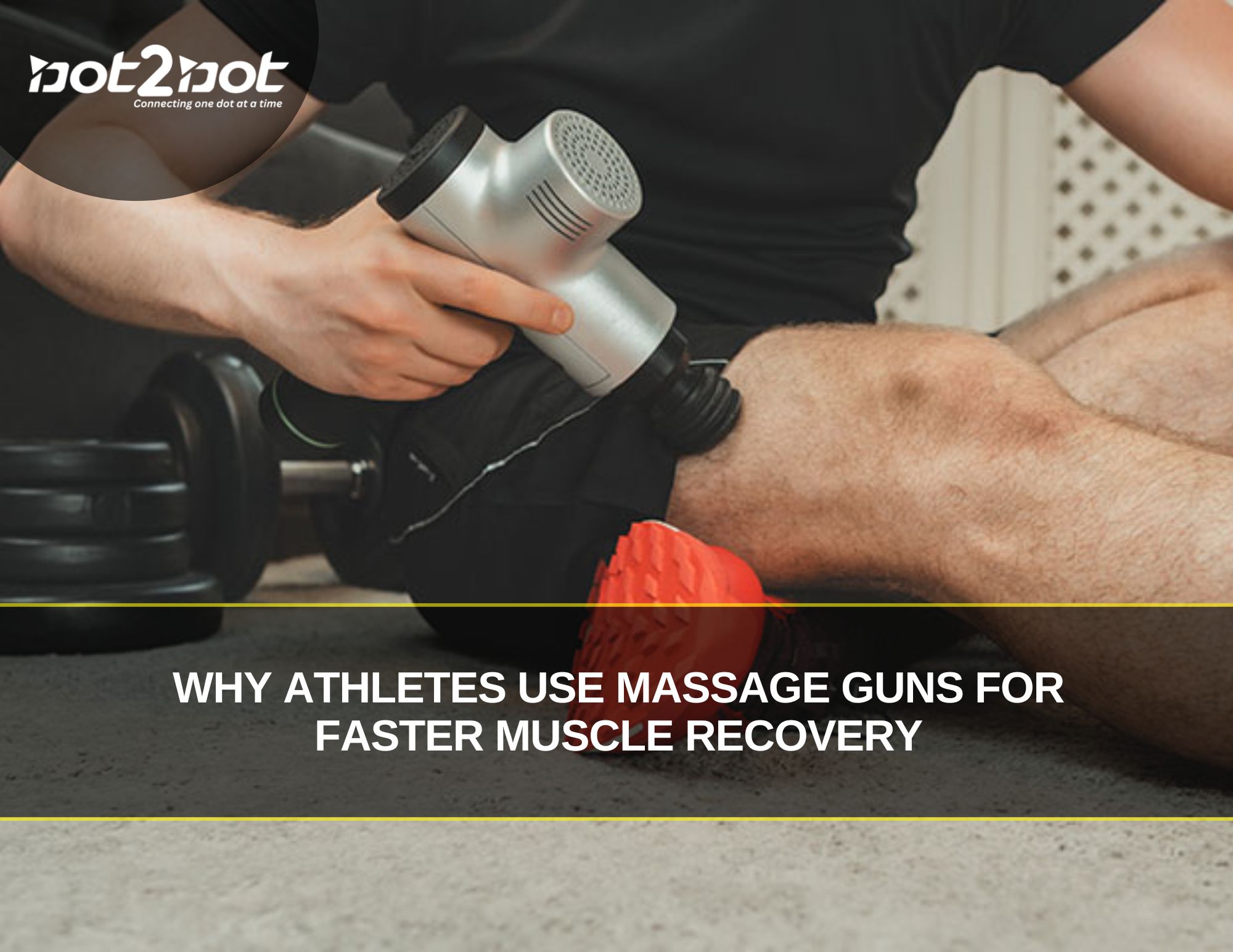
Step into any elite gym or professional locker room in 2026, and you will hear the sound. A rhythmic, staccato thump-thump-thump that sounds like a distant helicopter. That is the sound of percussion therapy, and it has completely revolutionized how athletes handle their recovery. We’ve moved past the era where a foam roller was the only tool in the bag. Today, the massage gun for athletes is the primary weapon against the “jagged” stiffness of Delayed Onset Muscle Soreness (DOMS).
But what is the actual difference between a standard vibration machine and a percussion gun? Is it just a louder version of the same thing? The answer lies in the science of mechanobiology. A massage gun isn’t just “beating” your muscles; it is hacking your body’s nervous system to get you back to your training faster and with less pain. Let’s look at the “Jackhammer Theory” and why percussion is the gold standard for athletic performance.
Percussion vs. Vibration: The Depth Debate
Most consumer massagers are “vibratory.” They use a high frequency but a very shallow “amplitude” (the distance the head moves). Vibration is great for skin vitalization and relaxing surface nerves, but it’s like a pebble skipping across the surface of a lake—it doesn’t reach the bottom.
Percussion therapy is different. A high-quality massage gun for athletes uses a “piston” action with a deep amplitude—usually between 10mm and 16mm. It doesn’t just buzz on the skin; it physically strikes the muscle tissue. This rapid, vertical jolt creates a seismic wave that penetrates deep into the muscle belly. This allows it to reach layers of fascia and deep-seated knots that human hands or simple vibrators can never touch.
Top 3 Benefits for the 2026 Athlete
- The DOMS Destroyer: Delayed Onset Muscle Soreness is the jagged stiffness you feel 24–48 hours after a heavy leg day. Research shows that percussion therapy can treat muscle fibers 30-times more effectively than regular massage. It flushes out metabolic waste like lactic acid before it has a chance to cause inflammation.
- Lymphatic Drainage on Autopilot: Because massage guns aggressively move fluid, they are excellent for the lymphatic system. This helps your body filter out toxins and reduces the “puffiness” or edema often seen in the legs after a marathon or long flight.
- Breaking Up Scar Tissue: After an injury, your fascia can develop “adhesions”—thickened spots where the tissue sticks together. The mechanical torque of a massage gun (often up to 80W) physically breaks these “micro-knots,” restoring smooth, velvety movement.
How to Use Your Gun Like a Pro: The Athlete’s Protocol
Using a massage gun isn’t about crushing the muscle. To get the best results, follow this clinical protocol used by physical therapists:
- The Float Method: Do not push the gun into your skin. Let the weight of the machine do the work. “Float” the head across the muscle belly.
- Identify the Grain: Move along the muscle fibers, not across them. For quads, move from hip to knee in long, slow sweeps.
- Pre-Workout (The Warm-up): Spend 30 seconds on each muscle group at a medium speed. This increases localized skin temperature and blood flow, preparing the tissue for explosive movement.
- Post-Workout (The Cool-down): Spend 2 minutes on sore areas at a low, pulsing speed. This activates the parasympathetic nervous system and speeds up the “clearing” process of lactic acid.
The “No-Go” Checklist: Avoiding Injury
A massage gun is a powerful recovery tool, not a toy. Never use it on:
- Bony Areas: The spine, shin, or elbow. Striking bone with a 12mm piston can cause stress fractures.
- The “Artery Alley”: The front of the neck or inner groin. High-frequency percussion here can disrupt blood flow or cause dizziness.
- Acute Tears: If you have a grade-3 muscle tear or significant swelling from a recent injury, a massage gun will likely cause more inflammation.
The Verdict
For the modern athlete, a massage gun is the single most powerful recovery tool in the bag. It provides professional-grade intensity on-demand, turning the jagged struggle of post-workout stiffness into an automated, efficient process. If you want to wake up feeling crisp and ready to move, rather than stiff and broken, percussion therapy is no longer an option—it is a requirement for the 2026 athlete.
Get More Info: https://dot2dot.pk/product-category/sports/massager/
Need help? Our support team is just a WhatsApp Message Away @ +92 346-240 9866 & +92 303-377 1783